Introduction to Indian Bank SO Success
Becoming a Specialist Officer (SO) at Indian Bank is a prestigious career milestone. Unlike General Banking Officer roles, the SO position demands a unique blend of high-level technical expertise and fundamental banking aptitude. To succeed, candidates must master the art of balancing deep domain knowledge with the speed and accuracy required for the general sections.
Understanding the Exam Blueprint
The Indian Bank SO examination is designed to test candidates on two distinct fronts: Professional Knowledge and General Aptitude. The professional section evaluates your expertise in your specific field (IT, Law, Agriculture, Finance, etc.), while the aptitude section tests your analytical and linguistic capabilities. A common mistake candidates make is over-preparing for the section they enjoy while neglecting the one they find challenging.
Mastering Your Domain: The Core Pillar
Your professional knowledge score is the primary driver of your final ranking. To excel here:
- Deep Dive into Fundamentals: Do not rely solely on summary notes. Refer to standard textbooks and industry-specific journals.
- Stay Updated with Regulations: For roles like Law or Finance, keep track of recent amendments, RBI circulars, and regulatory updates.
- Practical Application: Focus on how theoretical concepts are applied in the banking ecosystem.
Conquering General Aptitude
While domain knowledge gets you the interview, general aptitude ensures you clear the cut-off. The general section consists of Quantitative Aptitude, Reasoning, and English Language.
- Quantitative Aptitude: Focus on data interpretation, profit and loss, and percentages. Speed is key here; practice mental math daily.
- Reasoning Ability: Prioritize puzzles, syllogism, and logical reasoning. Practice these under timed conditions to simulate the exam environment.
- English Language: Enhance your reading comprehension and vocabulary. Regular newspaper reading helps in understanding complex sentence structures.
Strategic Time Management
Effective preparation requires a structured study plan. Break your day into blocks. Use the morning hours, when your brain is freshest, for complex technical topics. Dedicate the afternoon to solving mock tests and reviewing your errors. Spend your evenings on vocabulary building or light revision of formulas.
The Role of Mock Tests
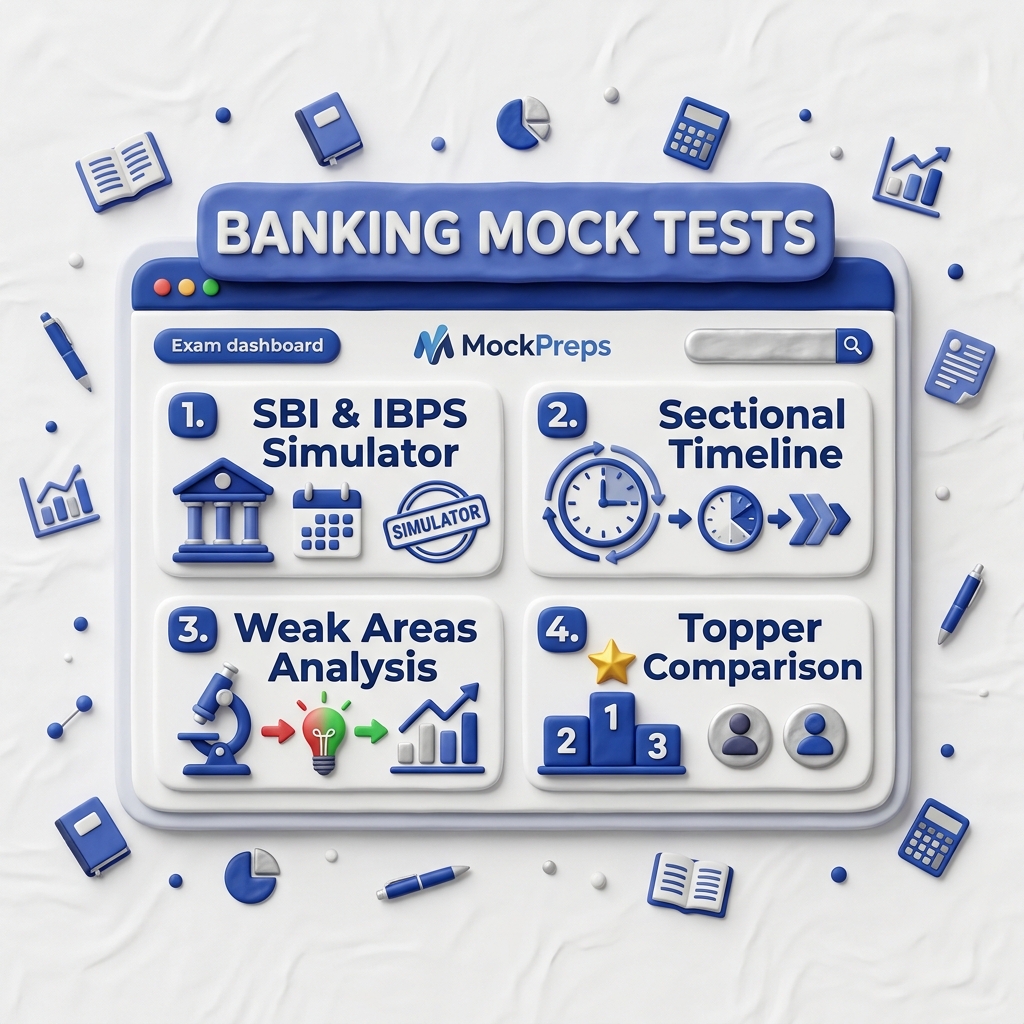
Mock tests are the mirror to your preparation. Attempting at least two full-length mock tests per week is non-negotiable. After each test, perform a 'Gap Analysis.' Identify why you lost marks: was it lack of knowledge, or was it a silly calculation error? Document these errors in a notebook to ensure they are not repeated.
Balancing Act: The Final Stretch
As the exam approaches, shift your focus from learning new topics to refining what you know. Review your notes, practice previous years' papers, and maintain a calm mindset. Remember, the Indian Bank SO exam is not just about intelligence; it is about stamina and strategic execution. By maintaining a balance between your technical prowess and aptitude speed, you position yourself as a top-tier candidate ready for the professional challenges of Indian Bank.
Frequently Asked Questions
Unlock MockPreps Pass Pro
Get direct access to the ultimate testing platform trusted by toppers. Upgrade to unlock full-length tests, detailed performance metrics, and smart tracking.
60,000+ Tests
Full mock series for all major exams.
Live Sessions
Compete with real-time test takers.
AI Speed Analytics
Pinpoint speed leaks & pacing guidelines.
Free Re-attempts
Perfect your accuracy via practice.
Popular Mock Test Series

SSC CGL Exam

Delhi Police Constable Exam

SSC CHSL Exam

SSC MTS Exam

Delhi Police Head Constable Exam

SSC CPO Exam