Mastering the Karnataka Bank PO Exam: A Strategic Guide
The Karnataka Bank Probationary Officer (PO) exam is a highly competitive gateway to a rewarding career in the banking sector. Success in this exam depends not just on what you know, but on how efficiently you can apply that knowledge under pressure. In a time-bound environment, speed and accuracy are the two pillars that differentiate successful candidates from the rest.
Understanding the Exam Dynamics
The Karnataka Bank PO exam typically evaluates candidates on Quantitative Aptitude, Reasoning Ability, English Language, General Awareness, and Computer Knowledge. Because the number of questions is high relative to the time provided, every second counts. Improving your performance requires a systematic approach that balances quick thinking with meticulous attention to detail.
Phase 1: Strengthening Foundational Concepts
Before chasing speed, you must ensure your concepts are crystal clear. If you struggle with basic formulas or logical rules, you will inevitably lose time re-reading questions or making calculation errors. Spend the first few weeks of your preparation solidifying your basics in:
- Quantitative Aptitude: Focus on percentages, ratios, averages, and number systems.
- Reasoning: Practice syllogisms, blood relations, and seating arrangement puzzles.
- English: Enhance your vocabulary and reading comprehension through daily newspaper editorials.
Phase 2: Techniques to Boost Speed
Once your fundamentals are strong, it is time to transition to speed-building techniques. Speed is a result of practice and the adoption of smart shortcuts.
1. Master Mental Math
Avoid using a pen and paper for simple calculations. Practice mental arithmetic during your daily routine. Learn shortcuts for finding squares, cubes, and percentages. For example, knowing that 16.66% is 1/6 can save you precious seconds in data interpretation sets.
2. The Art of Skipping
One of the biggest mistakes candidates make is getting stuck on a difficult question. Remember, every question carries the same weight. If a puzzle or a DI set is taking longer than 3 minutes, move on. You can always return to it if time permits.
3. Speed-Reading for English
In the English section, you don't need to read every word of a passage with extreme detail. Use the 'skimming and scanning' technique to identify keywords and understand the main idea, then refer back to the text only when answering specific questions.
Phase 3: Enhancing Accuracy
High speed is useless if your accuracy is low, especially since many bank exams involve negative marking. To improve accuracy:
- Read Questions Carefully: Often, candidates lose marks because they misread a "not" or a specific condition in the question. Read each question twice before attempting it.
- Elimination Strategy: In objective-type questions, use the elimination method to rule out obviously wrong options. This increases your probability of choosing the correct answer.
- Review Your Mocks: After every mock test, analyze the questions you got wrong. Identify whether the error was due to a conceptual gap, a calculation mistake, or a reading error.
The Role of Mock Tests and Analysis
Mock tests are the mirror of your preparation. To effectively use them:
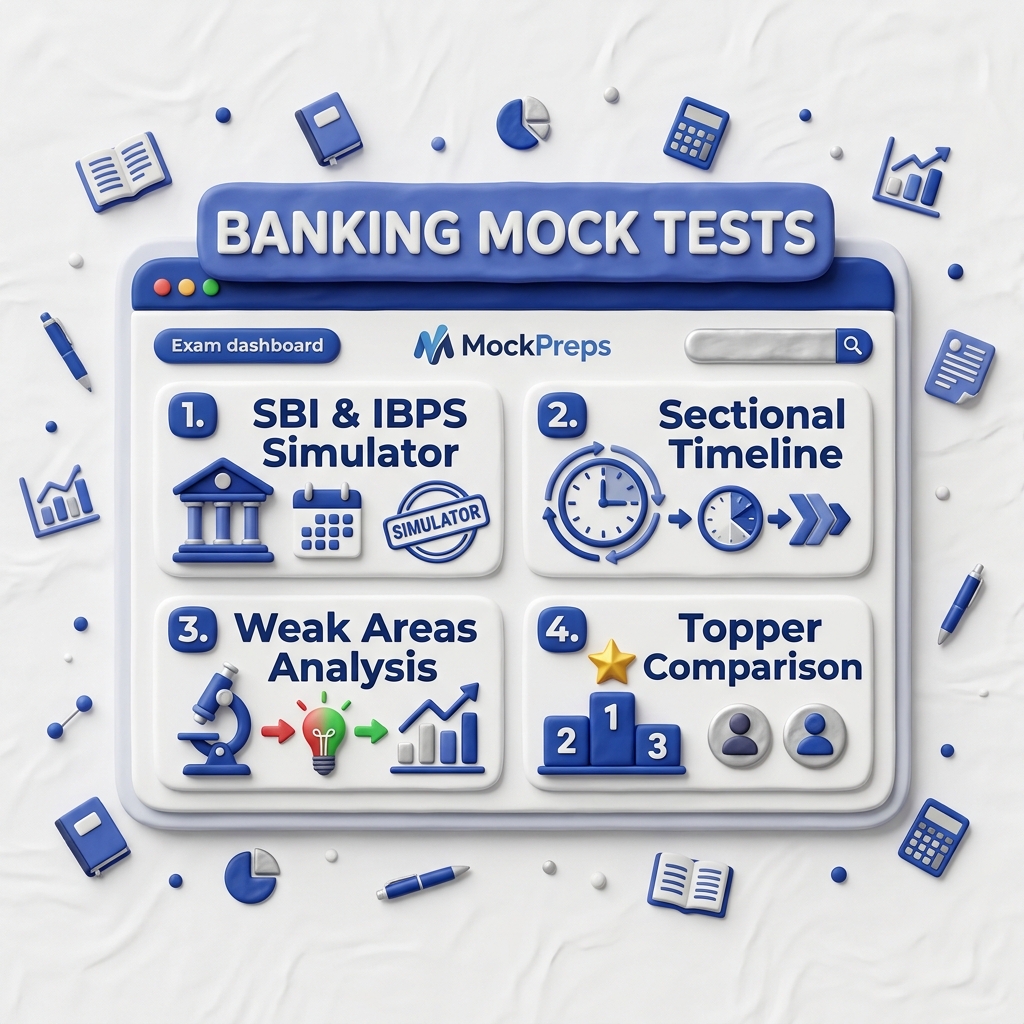
First, take full-length tests in an environment that mimics the actual exam hall. Second, perform a 'Deep Analysis.' For every test, categorize your attempts into 'Correct,' 'Incorrect,' and 'Unattempted.' Your goal is to maximize the 'Correct' category while minimizing the 'Incorrect' one. If your 'Unattempted' count is high, you need to work on your speed. If your 'Incorrect' count is high, you need to work on your accuracy.
Conclusion
Improving speed and accuracy for the Karnataka Bank PO exam is a journey of consistent effort. By building strong foundations, adopting smart shortcuts, and rigorously analyzing your performance, you can significantly enhance your chances of success. Stay disciplined, keep practicing, and maintain a positive mindset throughout your preparation process.
Frequently Asked Questions
Unlock MockPreps Pass Pro
Get direct access to the ultimate testing platform trusted by toppers. Upgrade to unlock full-length tests, detailed performance metrics, and smart tracking.
60,000+ Tests
Full mock series for all major exams.
Live Sessions
Compete with real-time test takers.
AI Speed Analytics
Pinpoint speed leaks & pacing guidelines.
Free Re-attempts
Perfect your accuracy via practice.
Popular Mock Test Series

SSC CGL Exam

Delhi Police Constable Exam

SSC CHSL Exam

SSC MTS Exam

Delhi Police Head Constable Exam

SSC CPO Exam